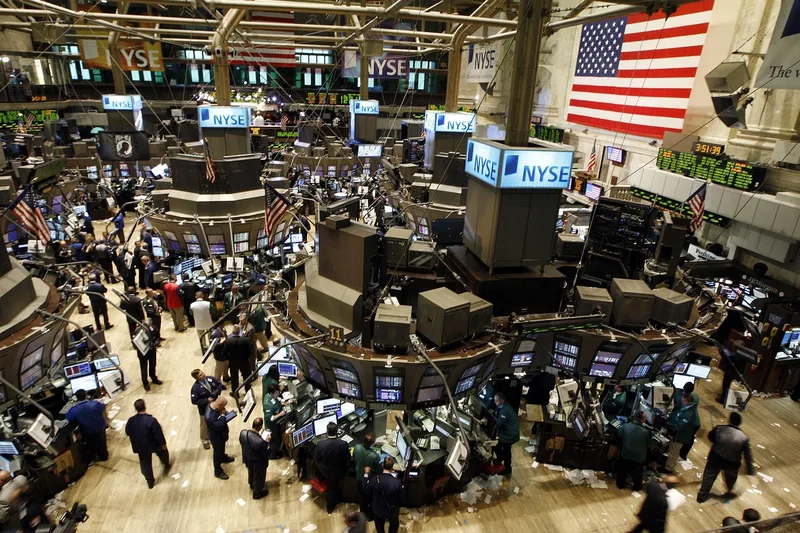
The S&P 500 closed at 7,520.93 on Tuesday, down 0.38%, after October inflation came in above forecasts and a Federal Reserve official signaled support for higher interest rates. The stock market gave back part of Monday's rally, with the Dow Jones Industrial Average down 0.30% to 52,231.89 and the Nasdaq Composite down 0.74% to 25,065.87.
By the numbers
- S&P 500: 7,520.93, down 29.01 points (-0.38%)
- Dow Jones Industrial Average: 52,231.89, down 157.86 points (-0.30%)
- Nasdaq Composite: 25,065.87, down 187.27 points (-0.74%)
- Russell 2000: 2,821.38, down 19.43 points (-0.68%)
- 10-year Treasury yield: 4.98%, up from 4.86%
- WTI crude oil: US$86.04 a barrel, down 0.93%
- Gold: US$4,030.20 an ounce, down 2.05%
- VIX volatility index: 19.46, down 0.46 points
Closing figures for Tuesday, November 10, 2026. Oil and gold are front-month futures prices. Market data: Yahoo Finance.
Read also US Treasury yields steady as investors await inflation data
What moved the market
The Bureau of Labor Statistics reported that headline consumer prices rose 0.4% in October from September, above the 0.3% economists expected, according to Sharecast. Core CPI, which strips out food and energy, rose 0.3% against a 0.2% forecast. Shelter costs added 0.3% and accounted for more than 30% of the monthly increase, while food prices rose 0.5% and energy 0.7%.
The report landed hours after Fed Gov. Christopher Waller said in London that if the underlying inflation measure rose 0.3%, "a stronger policy move may be needed," according to the Associated Press. He suggested the Fed consider a half-point increase rather than the usual quarter point at its December meeting. The core figure came in at exactly that 0.3% threshold.
Traders responded in the bond market. The 10-year Treasury yield climbed to 4.98% from 4.86%, a move that feeds into mortgage and other consumer borrowing costs. Higher rates also tend to weigh on richly valued stocks.
Oil offered little offset. WTI crude settled at US$86.04 a barrel, down 0.93%, while gold fell 2.05% to US$4,030.20 an ounce as yields and the dollar rose. The VIX volatility index eased 0.46 points to 19.46.
Stocks and sectors that stood out
Sector funds showed a split session. Financials led with a 0.52% gain, followed by energy at 0.44% and communication services at 0.37%. Technology lagged badly, with the technology sector fund down 1.15%, while materials and utilities also slipped.
Among individual names, Nvidia fell 5.47% to $168.89, the weakest performer on the Dow, according to Investing.com. Nike dropped 3.05% and Caterpillar 2.39%. UnitedHealth rose 1.89%, Amazon added 1.48% and Travelers gained 1.41%. Charter Communications jumped 10.61% on the S&P 500, while Skydance fell 7.59% and Moderna lost 6.75%.
Decliners outnumbered advancers by 1,904 to 963 on the NYSE and 2,253 to 1,221 on the Nasdaq, Investing.com reported.
What to watch next
The December Fed meeting is now the central event, with markets pricing a greater chance of a rate increase after Tuesday's data. Investors will parse coming inflation and labor readings for signs of whether price pressures are broadening beyond shelter and food. The NFIB small business optimism index slipped to 97.8 in October from 97.9, its lowest since June, a reminder that borrowing costs are already weighing on smaller firms.
FAQ
How did the S&P 500 close on Tuesday?
The S&P 500 fell 29.01 points, or 0.38%, to close at 7,520.93. The Dow lost 0.30% and the Nasdaq 0.74%.
Why did the stock market fall?
October CPI rose 0.4% month over month, above the 0.3% forecast, and core inflation matched the level Waller cited as grounds for a larger rate hike. Treasury yields jumped, pressuring technology shares in particular.